

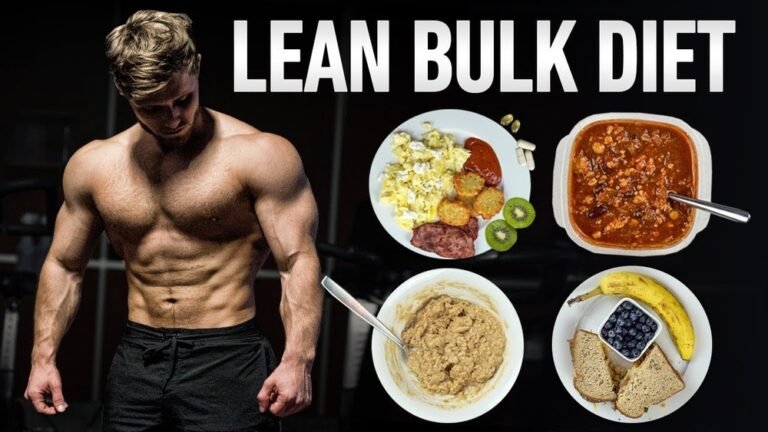
Losing fat while gaining muscle is a goal many people share, but few know how to achieve it efficiently. You might hear that you can only do one at a time—either burn fat or build muscle, not both. The truth is, with the right diet and smart strategies, you can see progress on both fronts. This approach is sometimes called “body recomposition,” and it’s not just for bodybuilders. Anyone—from beginners to experienced lifters—can benefit from understanding how nutrition and training work together for the best results. Let’s explore how you can create a lose fat gain muscle diet that works in real life.
Understanding Body Recomposition
Body recomposition means losing fat and gaining muscle at the same time. For most people, this is better than just losing weight because you improve your shape, strength, and health. When you lose only weight, you might lose muscle too, which slows your metabolism and makes it harder to keep the fat off.
Body recomposition works best if you follow a plan that supports muscle growth while encouraging your body to use stored fat for energy. This means eating enough protein, keeping a slight calorie deficit, and doing resistance training.
Key insight: Many people think they need a big calorie deficit to lose fat, but too large a deficit can actually stop muscle growth and even slow fat loss by lowering your metabolism.
How Nutrition Affects Fat Loss And Muscle Gain
Your diet is more important than your workout for changing your body. What you eat tells your body whether to burn fat, build muscle, or do neither. Here’s why:
- Calories decide if you lose, gain, or maintain weight.
- Macronutrients (protein, carbs, fat) decide if you lose fat, build muscle, or both.
- Micronutrients (vitamins, minerals) keep your body healthy, support energy, and help your muscles recover.
Let’s break down the essentials for a lose fat gain muscle diet.
Calorie Balance: The Foundation
Calories are the energy your body gets from food. To lose fat, you need to eat fewer calories than you burn. But to gain muscle, you need enough energy to build new tissue. So, what should you do?
Slight calorie deficit is the answer. If you cut too many calories, your body won’t have enough energy to build muscle. If you eat too much, you won’t lose fat.
A good starting point is a deficit of about 250–500 calories per day below your maintenance level. This allows steady fat loss while still supporting muscle growth if your protein and training are on point.
How To Find Your Calorie Needs
- Calculate your Basal Metabolic Rate (BMR): This is the calories your body needs at rest.
- Multiply by your activity level: This gives your Total Daily Energy Expenditure (TDEE).
- Subtract 250–500 calories: This is your target for fat loss with muscle gain.
Non-obvious insight: As you lose weight and gain muscle, your calorie needs will change. Adjust your calories every 4–6 weeks based on your results.
Protein: The Muscle Builder
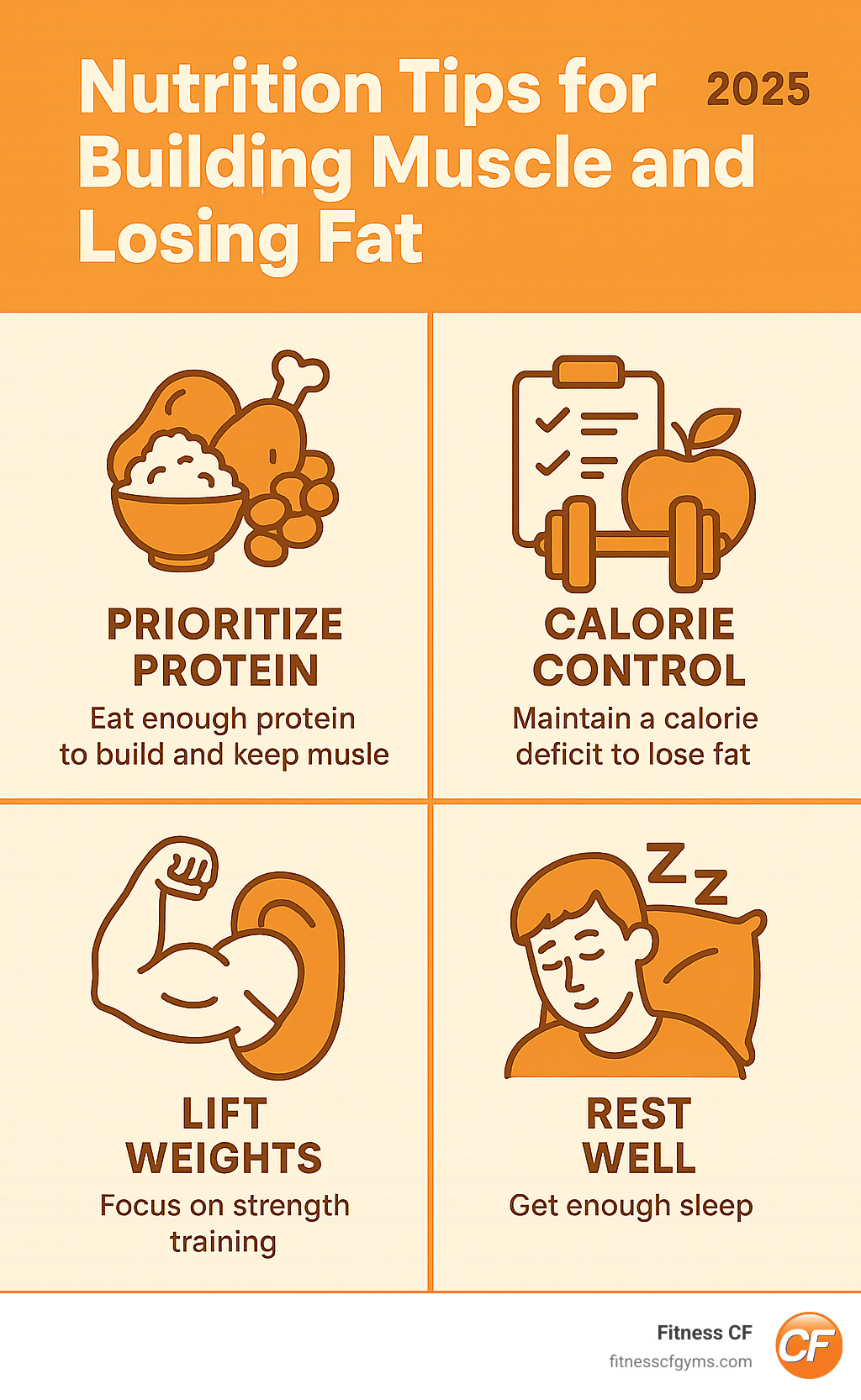
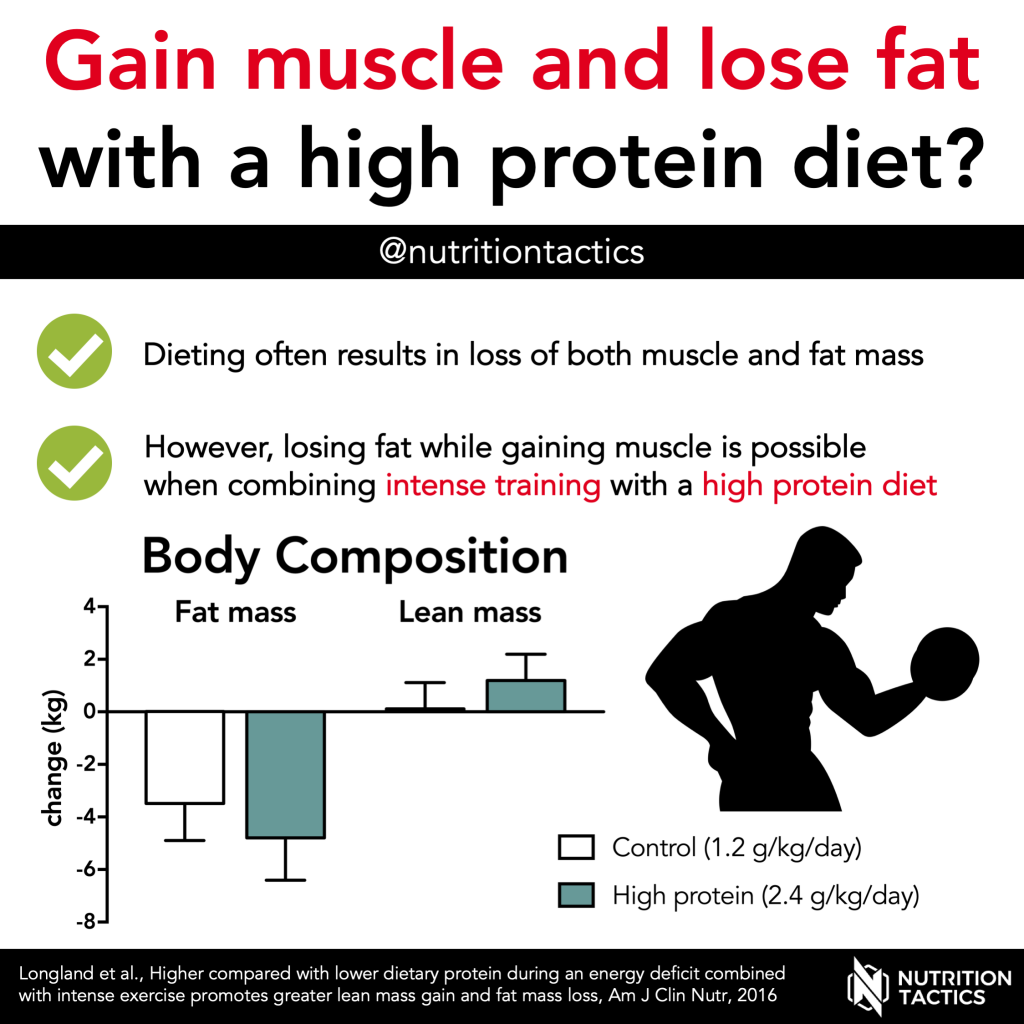
No nutrient is more important for body recomposition than protein. Protein provides the building blocks your muscles need to grow and repair. It also helps you feel full and supports fat loss by maintaining muscle when you’re in a calorie deficit.
How Much Protein Do You Need?
Aim for 1.6–2.2 grams of protein per kilogram of body weight (about 0.7–1 gram per pound). For someone who weighs 70 kg (154 lbs), that’s 112–154 grams per day.
| Body Weight (kg) | Minimum Protein (g) | Maximum Protein (g) |
|---|---|---|
| 60 | 96 | 132 |
| 70 | 112 | 154 |
| 80 | 128 | 176 |
| 90 | 144 | 198 |
Practical tip: Spread your protein intake across 3–5 meals per day, rather than eating it all at once. This helps your body use it more effectively for muscle growth.
Credit: fitnesscfgyms.com
Carbohydrates: Fuel For Performance
Carbohydrates are your body’s main source of energy during exercise. If you train hard with weights, you need enough carbs to power your workouts and help your muscles recover.
Low-carb diets can cause you to lose weight, but they often make your workouts feel harder and can slow muscle gain. Unless you have a medical reason to avoid carbs, include them in your diet.
Aim for 2–3 grams of carbs per kilogram of body weight as a starting point. Adjust based on your training intensity and results.
Non-obvious insight: Eating most of your carbs around your workout (before and after) can boost muscle recovery and energy, even if your total carb intake is moderate.
Fats: Essential For Hormones And Health
Dietary fat is not your enemy—your body needs it for hormone production, brain function, and absorbing vitamins. However, fat is calorie-dense (9 calories per gram), so eat enough for health but not so much that you go over your calorie target.
A good range is 0.7–1 gram of fat per kilogram of body weight. Try to get your fat from healthy sources like olive oil, nuts, seeds, fatty fish, and avocado.
Practical tip: Avoid very low-fat diets (under 20% of your calories from fat), as these can lower testosterone and other hormones that help with muscle growth.
Sample Lose Fat Gain Muscle Meal Plan
Planning your meals can make a big difference. Here’s a simple example for a 70 kg person aiming for 1800 calories, 140g protein, 180g carbs, and 60g fat.
Example Day
Breakfast:
- 2 eggs (140 cal, 12g protein, 10g fat)
- 1 slice whole grain bread (80 cal, 3g protein, 15g carbs)
- 1 apple (95 cal, 25g carbs)
Lunch:
- 120g grilled chicken breast (132 cal, 25g protein, 3g fat)
- 1 cup cooked brown rice (215 cal, 5g protein, 45g carbs)
- 1 cup steamed broccoli (55 cal, 4g protein, 12g carbs)
Snack:
- Greek yogurt, plain, 150g (90 cal, 15g protein, 5g carbs)
- 10 almonds (70 cal, 3g protein, 7g fat)
Dinner:
- 120g salmon (220 cal, 23g protein, 13g fat)
- 1 medium sweet potato (100 cal, 2g protein, 23g carbs)
- Salad with olive oil (100 cal, 1g protein, 11g fat)
Post-workout:
- Whey protein shake (120 cal, 24g protein, 3g carbs)
This plan gives a balance of all three macronutrients and uses whole foods for better nutrition.
Timing Your Meals For Best Results
You may hear about “nutrient timing” or the “anabolic window. ” While it’s not essential to eat right after your workout, having protein within 2 hours after training can help muscle recovery. For most people, focusing on total daily protein is more important than exact timing.
Key insight: Eating a meal with protein and carbs before your workout (1–2 hours before) and another after your workout (within 2 hours) is a simple, effective strategy.
Supplements: What Helps, What Doesn’t
Supplements are not magic. Most results come from your regular food. However, some supplements can make your diet easier or help fill gaps.
Useful Supplements
- Whey protein: Easy way to reach your protein goal.
- Creatine monohydrate: Supports muscle strength and growth.
- Vitamin D: If you don’t get much sun.
- Fish oil: For omega-3 fats, if you don’t eat much fatty fish.
Not Worth Your Money
- Fat burners: Often just caffeine or herbal mixes, little proven effect.
- BCAAs: Not needed if you eat enough protein.
- Test boosters: Most do not work.
Practical tip: Always check for third-party tested supplements to avoid low-quality products.
How To Track Progress
Tracking is key to success with any lose fat gain muscle diet. The scale alone can be confusing because you may gain muscle and lose fat at the same time, which could mean your weight stays the same.
Best Ways To Track
- Progress photos: Take pictures from the front, side, and back every 2–4 weeks.
- Body measurements: Use a tape measure for your waist, hips, chest, arms, and legs.
- Strength gains: Track your main lifts in the gym. More strength usually means more muscle.
- How your clothes fit: Looser waist but tighter arms and legs is a good sign.
| Tracking Method | What It Shows | How Often |
|---|---|---|
| Weight Scale | Total weight only | 1–2 times per week |
| Body Measurements | Fat loss/muscle gain areas | Every 2–4 weeks |
| Progress Photos | Body shape changes | Monthly |
| Strength Log | Performance gains | Every workout |
Non-obvious insight: During body recomposition, you may not see the scale change much. But your waist will shrink and your muscles will look fuller. This is real progress.
Credit: www.nutritiontactics.com
Common Mistakes To Avoid
Trying to lose fat and gain muscle at the same time is not easy. Many people make these mistakes:
- Cutting calories too much: This slows down muscle growth and metabolism.
- Not eating enough protein: Without enough protein, you risk losing muscle.
- Skipping resistance training: Cardio alone won’t build muscle.
- Changing plans too often: Stick with your plan for at least 8–12 weeks before judging results.
- Relying on the scale only: Body weight can mislead you during recomposition.
Key insight: Consistency beats perfection. It’s better to stick to a good plan most of the time than chase perfect results with extreme diets.
Building An Effective Lose Fat Gain Muscle Diet
Everyone’s needs are a little different. Here’s how to create a plan that works for you.
Step 1: Set Your Calories
- Find your TDEE (use an online calculator or multiply your body weight (kg) by 30–35 for a rough estimate).
- Subtract 250–500 calories for your target.
Step 2: Set Your Protein
- Multiply your weight (kg) by 1.6–2.2 for daily grams.
Step 3: Set Your Fats
- Multiply your weight (kg) by 0.7–1 for daily grams.
Step 4: Fill In Carbs
- Remaining calories can come from carbs.
- Each gram of protein or carb = 4 calories, fat = 9 calories.
Example:
If your target is 1800 calories, with 140g protein (560 cal), 60g fat (540 cal), the rest (700 cal) comes from carbs (about 175g).
Step 5: Choose Whole Foods
Focus on foods that are:
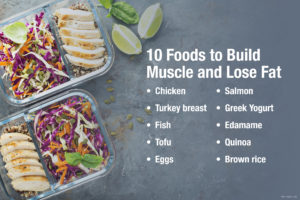
- High in protein: Chicken, fish, eggs, Greek yogurt, tofu, beans.
- High in fiber: Vegetables, fruits, whole grains.
- Healthy fats: Olive oil, nuts, seeds, avocado.
- Complex carbs: Brown rice, oats, potatoes, quinoa.
Practical tip: Prepare meals ahead of time to avoid unhealthy choices when busy or tired.
The Role Of Resistance Training
No diet can build muscle without resistance training. Lifting weights or using bodyweight exercises tells your body to use the food you eat for muscle, not fat.
Key principles:
- Train each muscle group 2 times per week.
- Use compound exercises (squats, deadlifts, bench press, pull-ups).
- Progressively add weight or reps over time.
- Don’t overtrain—recovery is as important as exercise.
Non-obvious insight: Beginners can see fast results from even simple training. But as you get more advanced, you need more careful planning and sometimes “bulking” or “cutting” cycles.
Cardio: How Much And What Type?
Cardio helps burn calories, but too much can hurt muscle growth if you don’t eat enough. For most people:
- 2–3 sessions per week of moderate cardio (20–40 minutes)
- Or, short intense sessions (HIIT) 1–2 times per week
Walking is also great and does not harm muscle.
Practical tip: Do cardio after weights, not before, to keep your strength up for lifting.
Credit: www.nmkishhwc.com
Eating Out And Social Events
You won’t always be able to eat perfectly. Here’s how to stay on track:
- Check menus online before going out.
- Choose grilled or baked proteins, salads, and veggies.
- Ask for sauces and dressings on the side.
- Control portions—stop when you’re 80% full.
- If you overeat, don’t skip meals the next day. Just return to your normal plan.
Non-obvious insight: One meal will not ruin your progress. It’s what you do most of the time that counts.
The Importance Of Sleep And Stress
Diet and exercise are key, but sleep and stress matter too. Poor sleep lowers muscle growth and increases cravings. High stress raises cortisol, which can cause fat gain.
- Aim for 7–9 hours of sleep per night.
- Use stress-reduction techniques: Meditation, walking, hobbies.
- Avoid screens 1 hour before bed for better sleep quality.
Women’s Needs Vs. Men’s Needs
The basics are the same for men and women, but some details differ.
Women:
- May need slightly more fat for hormone health.
- Can lose muscle faster during very low-calorie diets.
- Benefit from resistance training just as much as men.
Men:
- May gain muscle faster, but also store fat more easily if overeating.
- Need to watch for “ego lifting”—using too much weight with bad form.
Non-obvious insight: Women do not “bulk up” easily; lifting weights shapes and tones without adding unwanted size.
Vegetarian And Vegan Approaches
You can lose fat and gain muscle on a plant-based diet. The main challenge is getting enough protein.
- Combine different plant proteins: Beans and rice, lentils and whole grains.
- Use tofu, tempeh, seitan, and plant-based protein powders.
- Include nuts and seeds for healthy fats.
Practical tip: Track your protein for a week to see if you meet your needs. Many vegetarians/vegans fall short.
Adjusting Your Diet Over Time
As you progress, your body changes. The same diet that worked at first might stop working later.
- If fat loss slows, reduce calories by 100–200 per day, or add a little more activity.
- If you stop gaining strength, check your sleep, protein, and recovery.
- If you’re always hungry or tired, you may need to eat a little more or adjust your macros.
Non-obvious insight: Most plateaus are normal. Don’t quit or switch plans too quickly.
Science And Studies
Research shows that with the right diet and resistance training, people can lose fat and gain muscle at the same time—even in their 40s and 50s. For deeper reading, see this review from the Wikipedia page on body recomposition.
Frequently Asked Questions
Can I Lose Fat And Gain Muscle At The Same Time?
Yes, especially if you are a beginner, returning after a break, or have not trained seriously before. With a good diet and resistance training, your body can build muscle while using fat stores for energy.
How Long Does Body Recomposition Take?
Results are slow but steady. Most people see noticeable changes in 8–12 weeks, but full transformation may take 6–12 months. Patience and consistency are key.
Do I Need To Count Calories To Succeed?
It helps at first, but you don’t have to count forever. Counting teaches you about portion sizes and macros. Over time, you can eat by feel and adjust based on your results.
Is Cardio Necessary For Losing Fat And Gaining Muscle?
No, but it can speed up fat loss and improve heart health. Resistance training is more important for muscle gain. Combine both for best results.
Should I Eat Differently On Workout And Rest Days?
You can keep calories and macros the same, or eat a little more carbs on workout days and a little less on rest days. The most important thing is hitting your weekly targets.
A lose fat gain muscle diet is not a quick fix, but with smart choices, steady training, and patience, you can change your body and health for life. Remember, the right plan is the one you can stick to and enjoy. Start simple, track your progress, and keep adjusting. Your future self will thank you.